Web cookies (also called HTTP cookies, browser cookies, or simply cookies) are small pieces of data that websites store on your device (computer, phone, etc.) through your web browser. They are used to remember information about you and your interactions with the site.
Purpose of Cookies:
Session Management:
Keeping you logged in
Remembering items in a shopping cart
Saving language or theme preferences
Personalization:
Tailoring content or ads based on your previous activity
Tracking & Analytics:
Monitoring browsing behavior for analytics or marketing purposes
Types of Cookies:
Session Cookies:
Temporary; deleted when you close your browser
Used for things like keeping you logged in during a single session
Persistent Cookies:
Stored on your device until they expire or are manually deleted
Used for remembering login credentials, settings, etc.
First-Party Cookies:
Set by the website you're visiting directly
Third-Party Cookies:
Set by other domains (usually advertisers) embedded in the website
Commonly used for tracking across multiple sites
Authentication cookies are a special type of web cookie used to identify and verify a user after they log in to a website or web application.
What They Do:
Once you log in to a site, the server creates an authentication cookie and sends it to your browser. This cookie:
Proves to the website that you're logged in
Prevents you from having to log in again on every page you visit
Can persist across sessions if you select "Remember me"
What's Inside an Authentication Cookie?
Typically, it contains:
A unique session ID (not your actual password)
Optional metadata (e.g., expiration time, security flags)
Analytics cookies are cookies used to collect data about how visitors interact with a website. Their primary purpose is to help website owners understand and improve user experience by analyzing things like:
How users navigate the site
Which pages are most/least visited
How long users stay on each page
What device, browser, or location the user is from
What They Track:
Some examples of data analytics cookies may collect:
Page views and time spent on pages
Click paths (how users move from page to page)
Bounce rate (users who leave without interacting)
User demographics (location, language, device)
Referring websites (how users arrived at the site)
Here’s how you can disable cookies in common browsers:
1. Google Chrome
Open Chrome and click the three vertical dots in the top-right corner.
Go to Settings > Privacy and security > Cookies and other site data.
Choose your preferred option:
Block all cookies (not recommended, can break most websites).
Block third-party cookies (can block ads and tracking cookies).
2. Mozilla Firefox
Open Firefox and click the three horizontal lines in the top-right corner.
Go to Settings > Privacy & Security.
Under the Enhanced Tracking Protection section, choose Strict to block most cookies or Custom to manually choose which cookies to block.
3. Safari
Open Safari and click Safari in the top-left corner of the screen.
Go to Preferences > Privacy.
Check Block all cookies to stop all cookies, or select options to block third-party cookies.
4. Microsoft Edge
Open Edge and click the three horizontal dots in the top-right corner.
Go to Settings > Privacy, search, and services > Cookies and site permissions.
Select your cookie settings from there, including blocking all cookies or blocking third-party cookies.
5. On Mobile (iOS/Android)
For Safari on iOS: Go to Settings > Safari > Privacy & Security > Block All Cookies.
For Chrome on Android: Open the app, tap the three dots, go to Settings > Privacy and security > Cookies.
Be Aware:
Disabling cookies can make your online experience more difficult. Some websites may not load properly, or you may be logged out frequently. Also, certain features may not work as expected.
Professor Puckett was at Jefferson Lab the week of January 23-27 to give an invited talk on the science that would be enabled by a potential future energy upgrade of CEBAF to 22 GeV, for the Jefferson Lab Users’ Organization Board of Directors Meeting, and for the Hall A Winter Collaboration Meeting.
The invited talk at the high-energy workshop can be viewed here.
At the Hall A Meeting, Professor Puckett and his graduate students Provakar Datta and Sebastian Seeds all gave invited talks, see below:
Graduate students from the SBS collaboration won the first (Provakar Datta, UConn) and 3rd (Maria Satnik, College of William and Mary) prizes and an honorable mention (Sebastian Seeds, UConn) in the graduate student poster competition at the Jefferson Lab Users’ Organization annual meeting.
Links to the posters and short video overviews of the posters can be found at the following link:
Current UConn PhD students and group members Provakar Datta and Sebastian Seeds were accepted to the National Nuclear Physics Summer School (NNPSS) to take place at MIT this July.
From Oct. 2021-Feb. 2022, experiments E12-09-019 and E12-20-008 were completed in Jefferson Lab’s Experimental Hall A. Data were collected that will determine the neutron’s magnetic form factor (GMN) in a previously unexplored Q2 regime up to 13.6 (GeV/c)2 with unprecedented precision. These experiments were the first large-scale deployment and operation of Gas Electron Multipliers (GEMs) in the high-luminosity, high-radiation, high-background-rate environment in Hall A. The GEMs were used in this experiment for charged-particle tracking through the BigBite Spectrometer. Given the large channel count and the high occupancy of the BigBite GEMs in Hall A (approximately 42,000 readout strips with up to 30-40% of these firing in every event), the SBS GMN run produced 2 petabytes of raw data (or typically about 1 GB/s during beam-on conditions). This is roughly 5 times as much raw data produced in four months of beam time in Hall A as the previous 25 years of Hall A running combined. The UConn group was one of the most actively involved in the preparation and execution of the experiment, developed the Monte Carlo simulation, event reconstruction and data analysis software, and is now leading the analysis of the collected data. Two UConn Ph.D. students will write their doctoral dissertation on the analysis of the SBS GMN dataset.
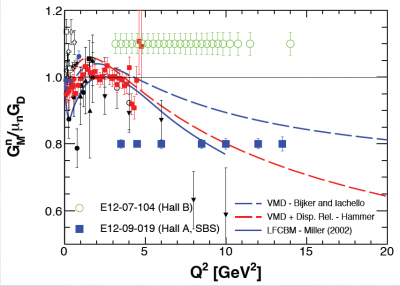
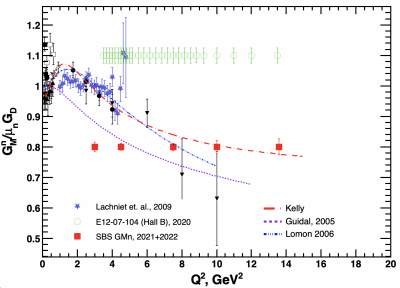
Fig. 1: Projected Q^2 points and expected precision of the data for the neutron’s magnetic form factor obtained from the SBS GMN run during Oct.-Feb., 2021-2022
Figure 1 shows the collected Q^2 points for the extraction of GMN and the projected accuracy based on the data obtained, compared to existing data, selected theoretical models, and the projected Q2 coverage and precision of a measurement in Hall B with similar physics goals, but qualitatively different sources of systematic uncertainty.
The example event distributions shown below were obtained at an incident electron beam energy of 6 GeV and Q2 = 4.5 GeV2:
Figure 2 (above) shows the invariant mass distributions for reconstructed electrons in BigBite, from the hydrogen (left) and deuterium (right) targets, before and after applying cuts on the angle between the reconstructed momentum transfer direction and the reconstructed scattering angle of the nucleon (proton or neutron) detected in the SBS hadron calorimeter (HCAL). The hydrogen distribution shows a clear peak at the proton mass corresponding to elastic scattering, and the angular correlation cut removes most of the inelastic background, while keeping most of the events in the elastic proton peak. The deuterium distribution is “smeared” by the Fermi momentum of the bound nucleons in deuterium, and the distributions of events passing the angular correlation cut under the hypothesis that the detected nucleon is a proton (red) or neutron (blue) illustrate the relatively clean selection of quasi-elastic scattering and rejection of most inelastic events using the SBS dipole magnet and hadron calorimeter.
Figure 3 (above) illustrates the method for nucleon charge identification using the SBS dipole magnet and the SBS hadron calorimeter. The plot shows the difference in vertical position between the detected nucleon at HCAL and the expected position predicted from the reconstructed electron kinematics assuming elastic (or quasi-elastic) scattering. The distributions are shown for hydrogen and deuterium targets for three different SBS magnetic field settings (magnet off, 70% of maximum field, 100% of maximum field). The hydrogen distributions show a single peak corresponding to elastic electron-proton scattering, that moves as the SBS magnetic deflection is varied. The deuterium distribution with field off shows a single nucleon (proton plus neutron) peak, smeared by Fermi motion. The deuterium distributions with SBS field on show a clear separation into proton (deflected) and neutron (undeflected) peaks, with protons undergoing the same average deflection as seen with the hydrogen target.
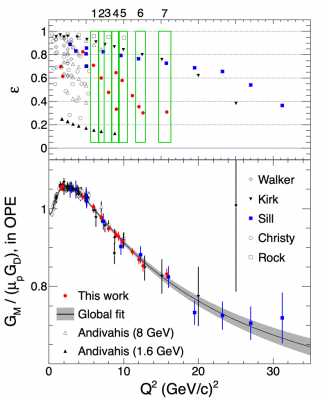
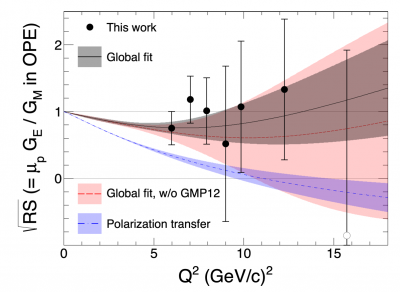
New precision cross section measurements for high-energy elastic electron-proton scattering from Jefferson Lab’s Hall A have recently been published in Physical Review Letters. The measurements significantly improve the precision of the world’s knowledge of the proton magnetic form factor at large momentum transfers and establish that the discrepancy between extractions of the proton’s electric/magnetic form factor ratio from cross section and polarization measurements persists to large values of Q2. The supplemental material for the publication can be found here. The preprint of the accepted manuscript, titled “Form Factors and Two-Photon Exchange in High-Energy Elastic Electron-Proton Scattering” can be found on the arXiv.
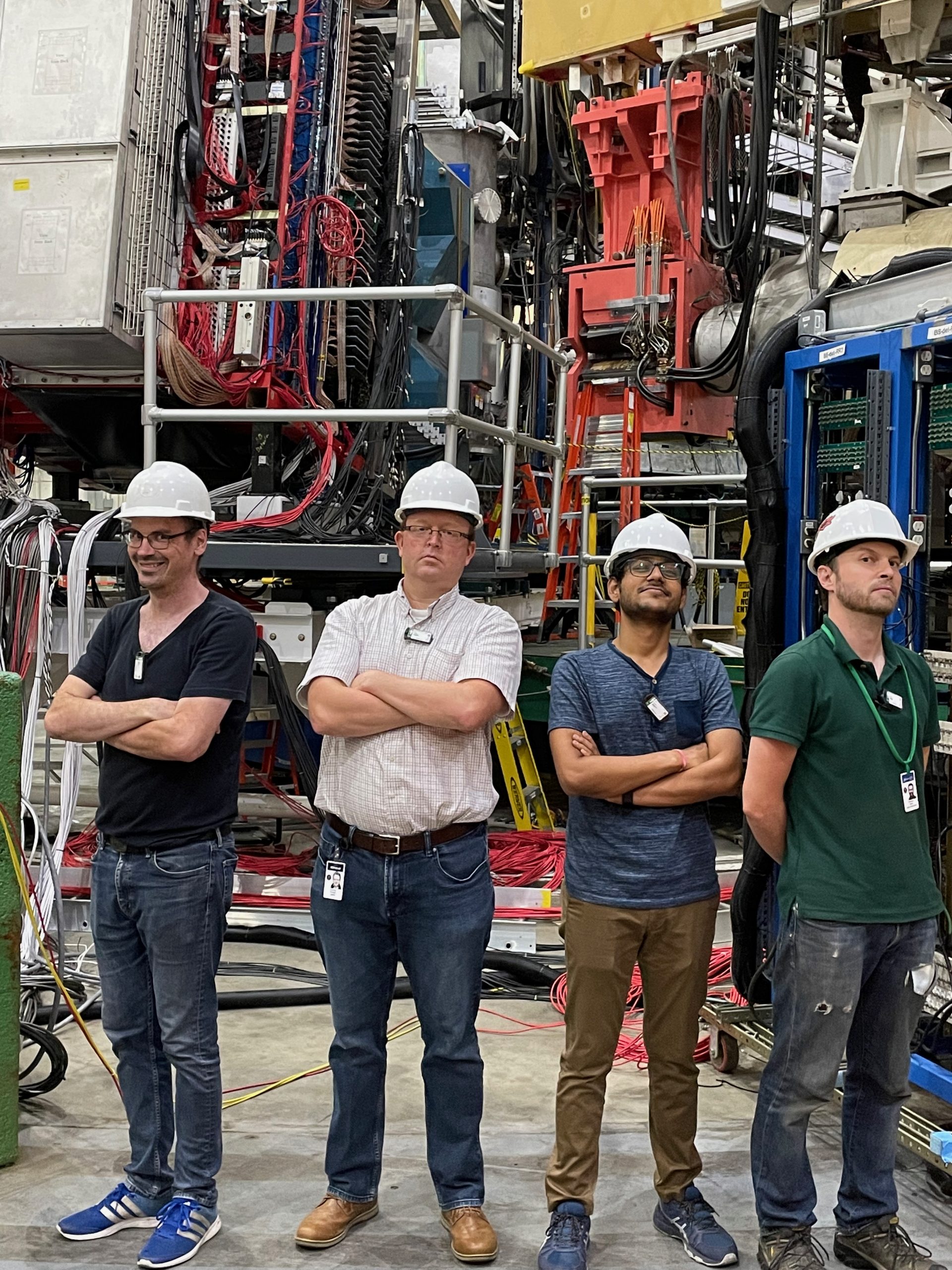
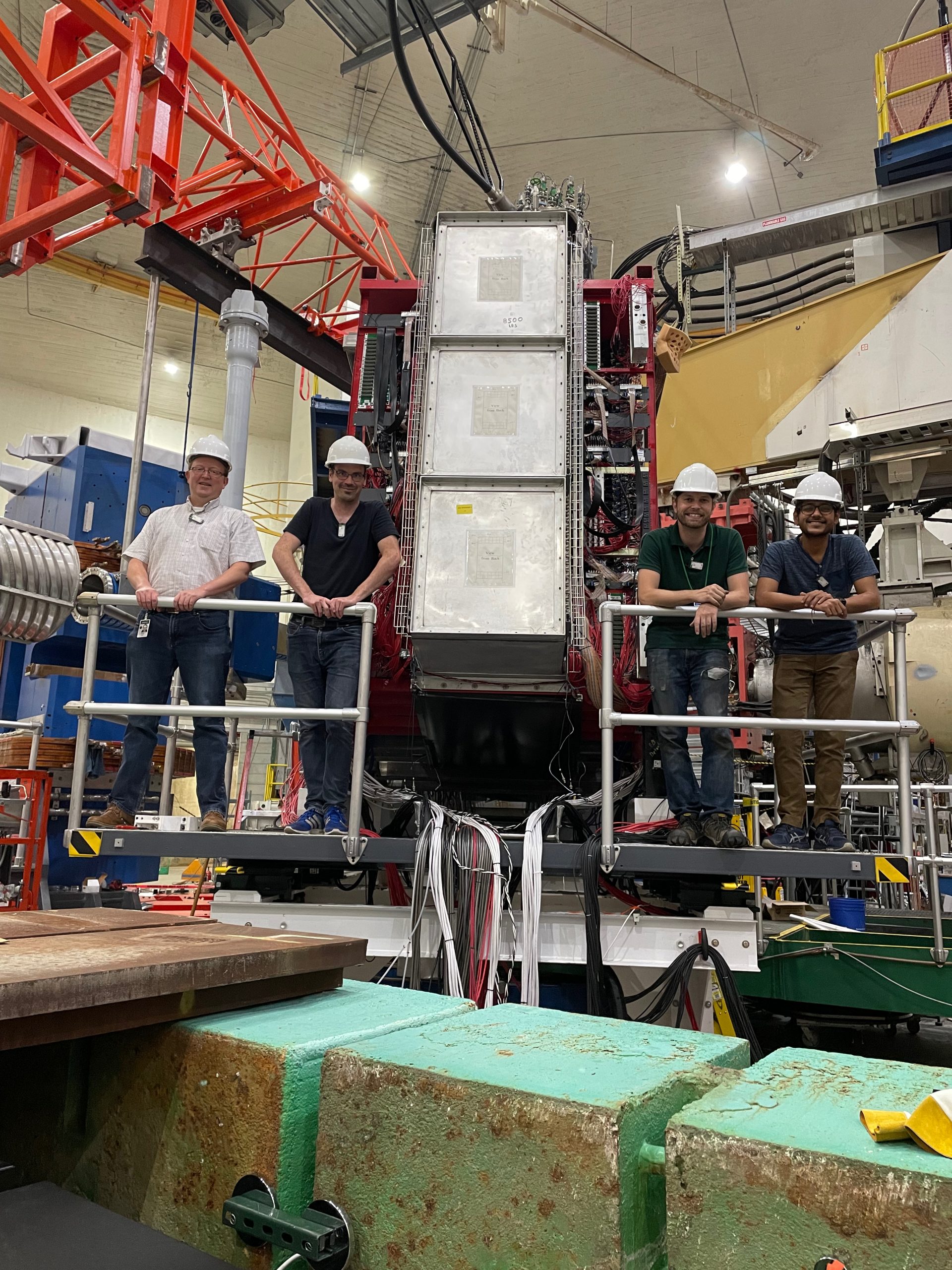
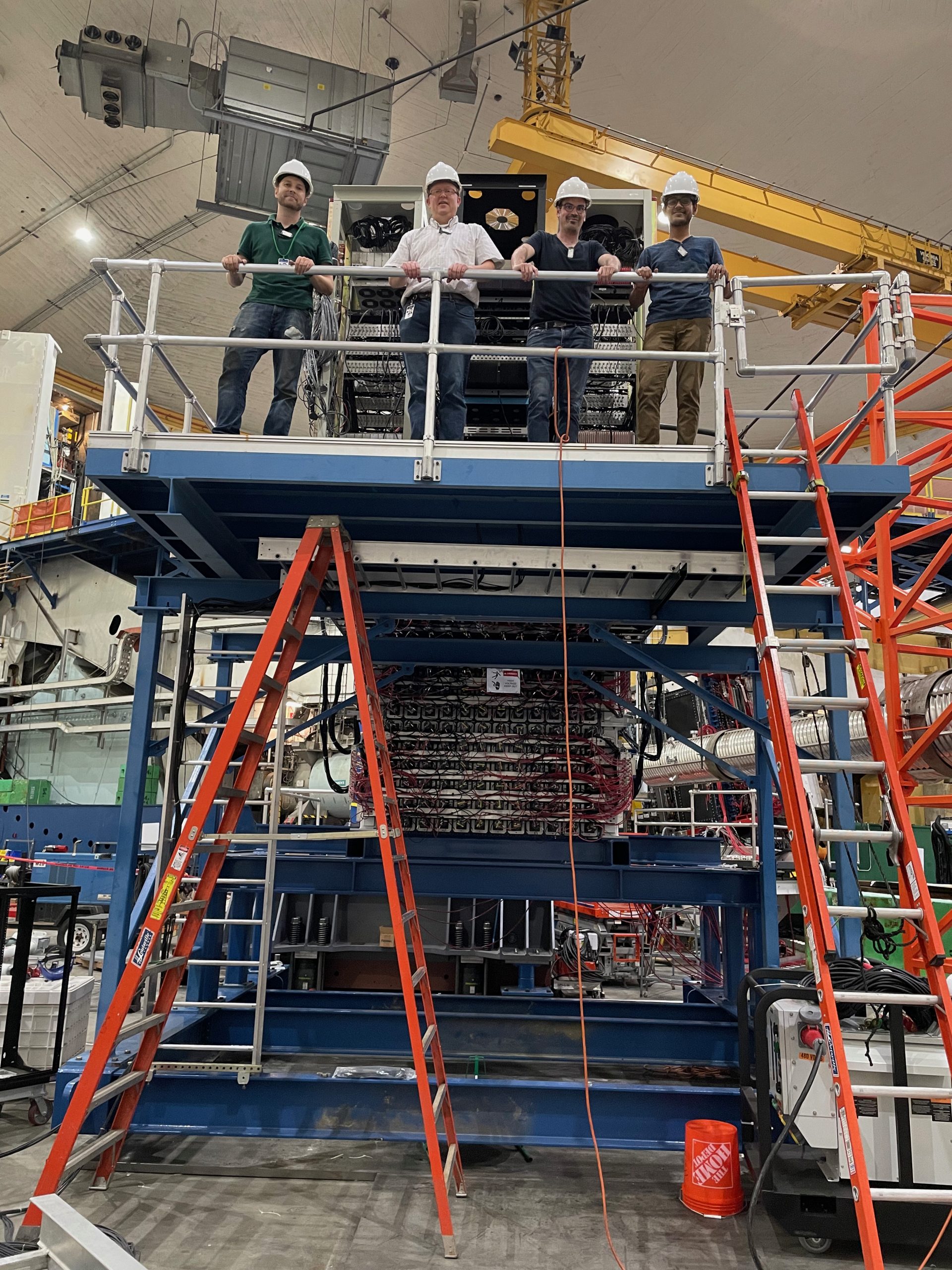
The UConn group on the floor of Hall A, in front of the BigBite Spectrometer. From left to right: Postdoctoral Research Associate Eric Fuchey, Professor Andrew Puckett, and Graduate Research Assistants Provakar Datta and Sebastian Seeds
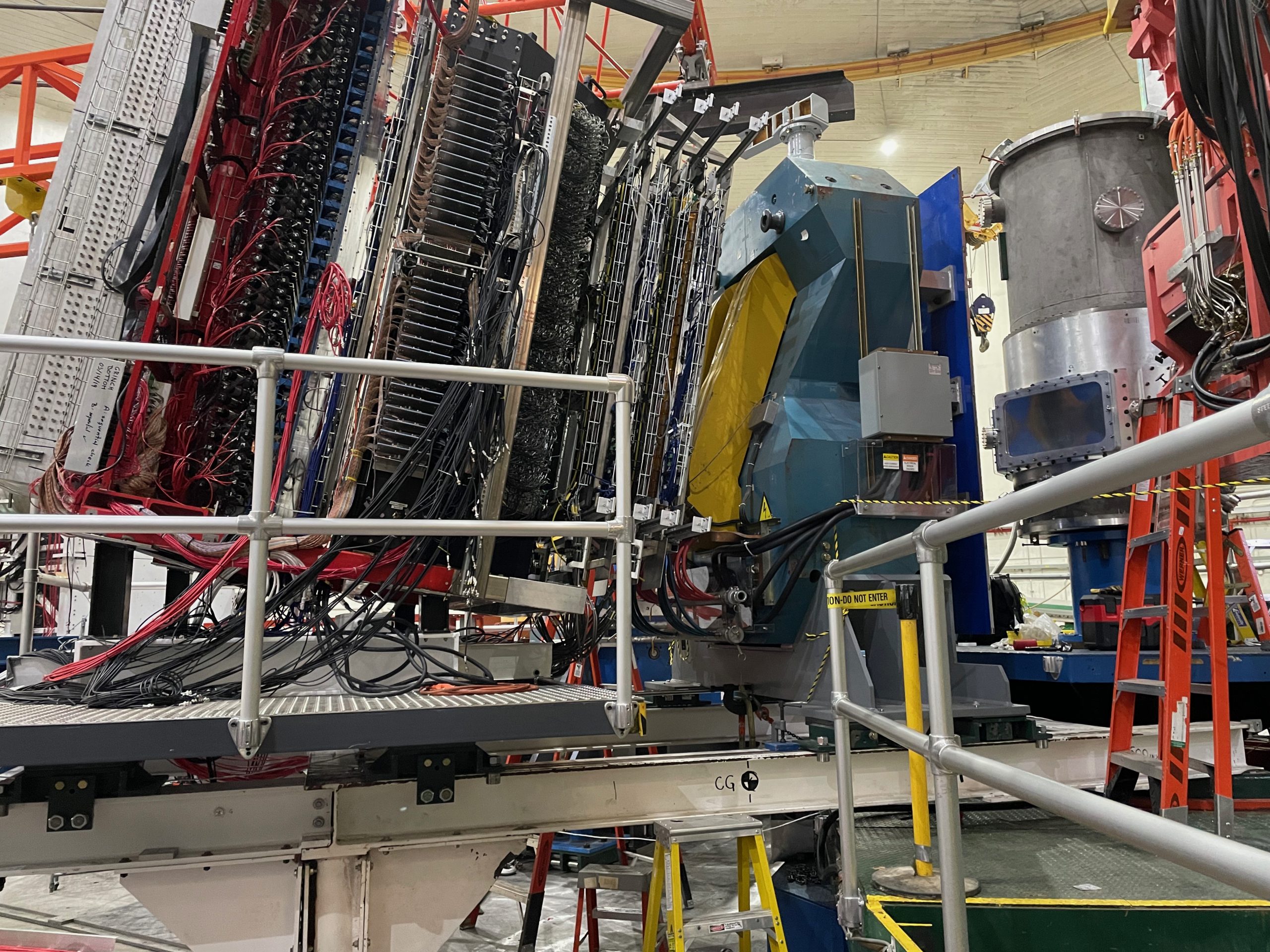
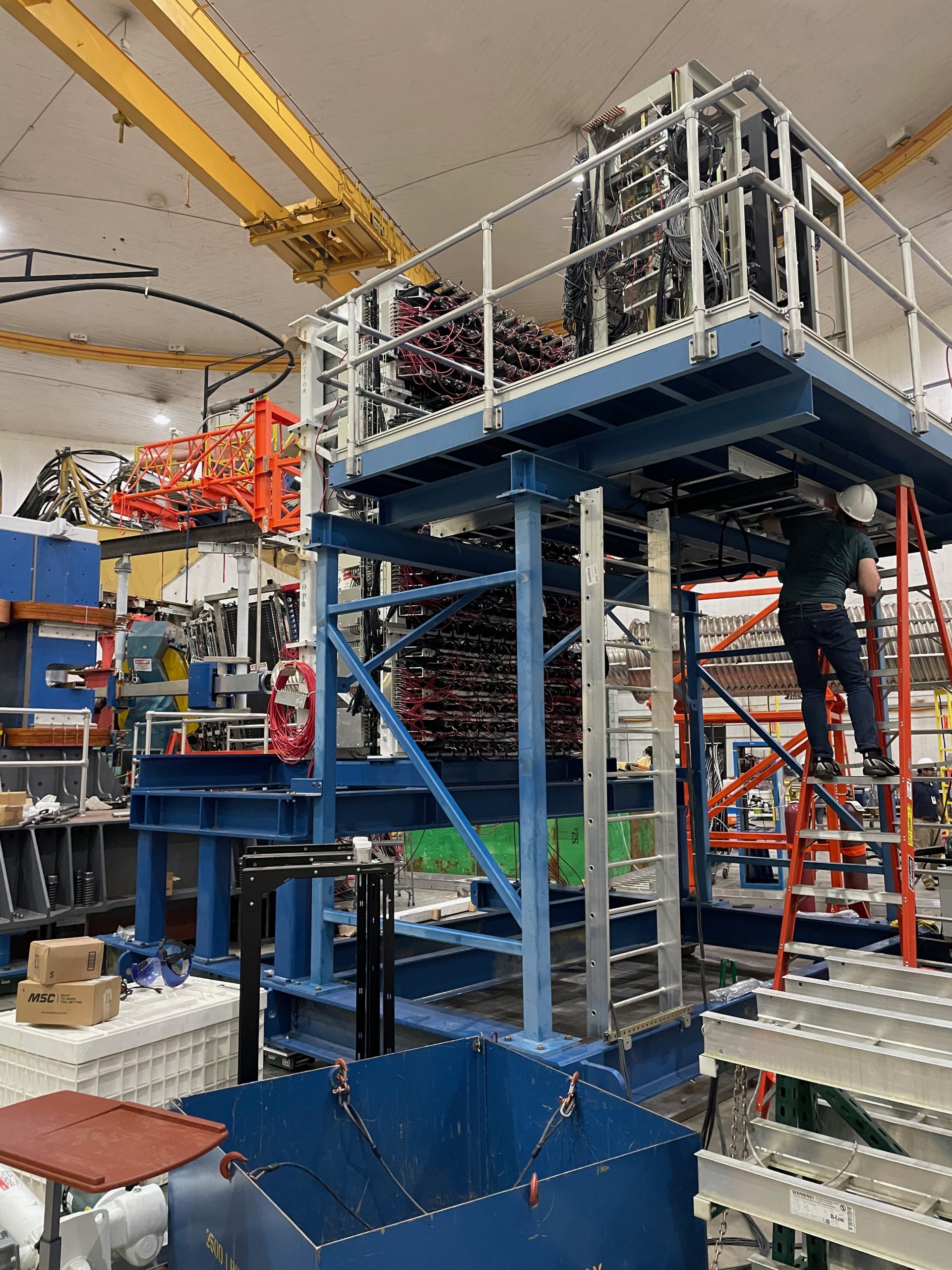
BigBite Spectrometer and target scattering chamber in Hall A, July 27, 2021, with magnet and detector package. BigBite will detect electrons that undergo hard collisions with protons and neutrons in the liquid hydrogen and deuterium targets in the evacuated scattering chamber.
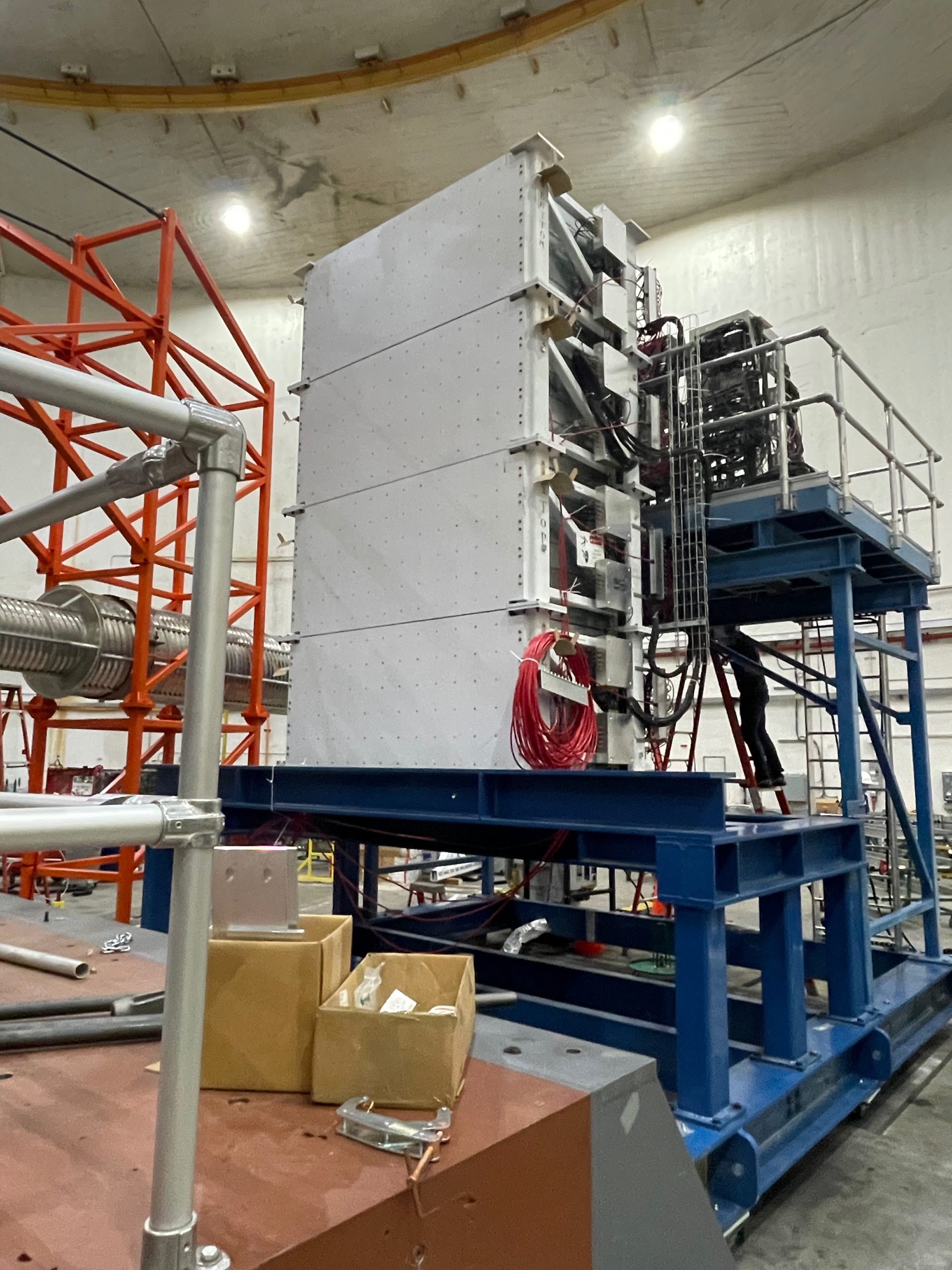
Front view of the SBS Hadron calorimeter that will detect high-energy protons and neutrons.
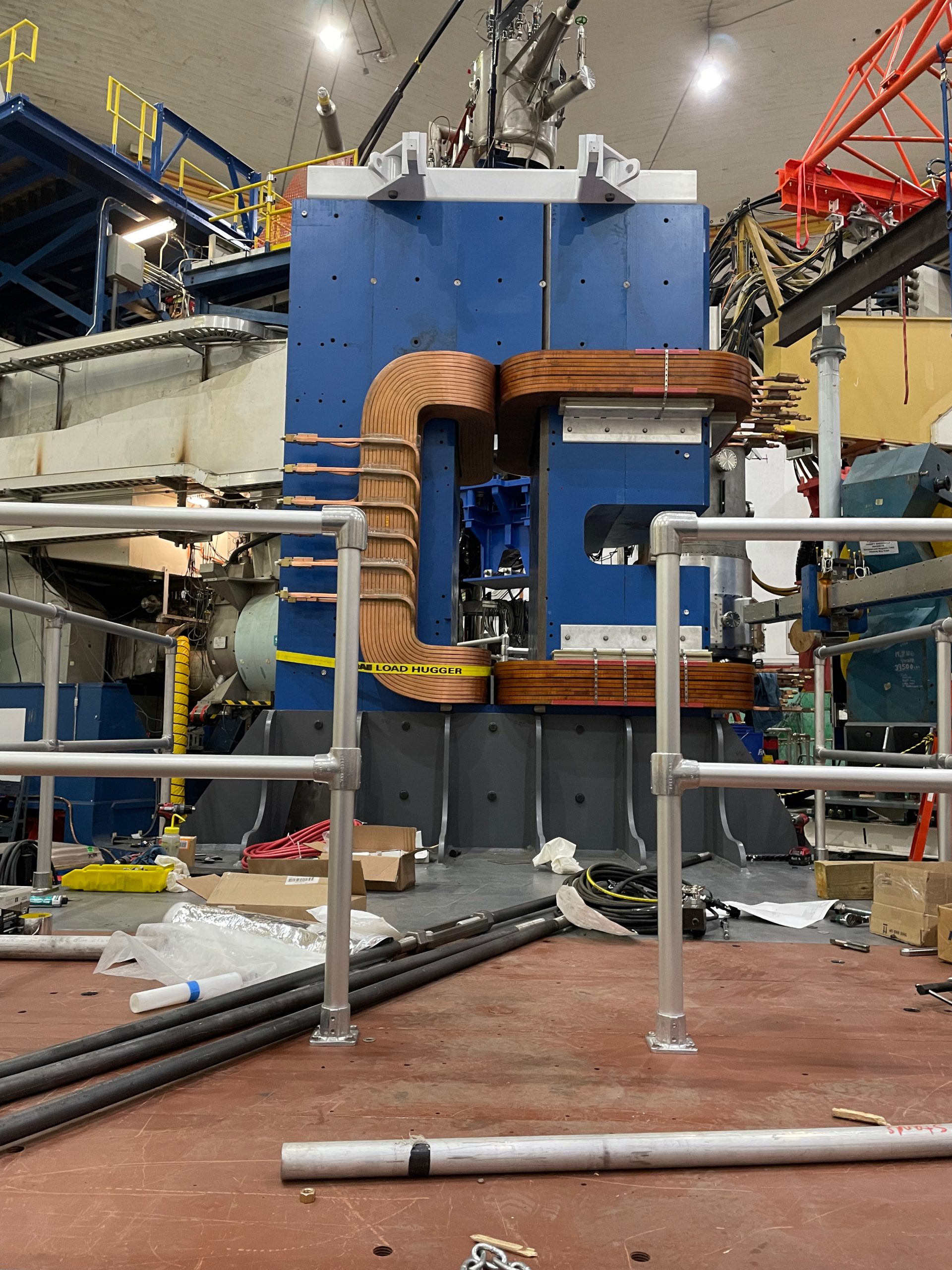
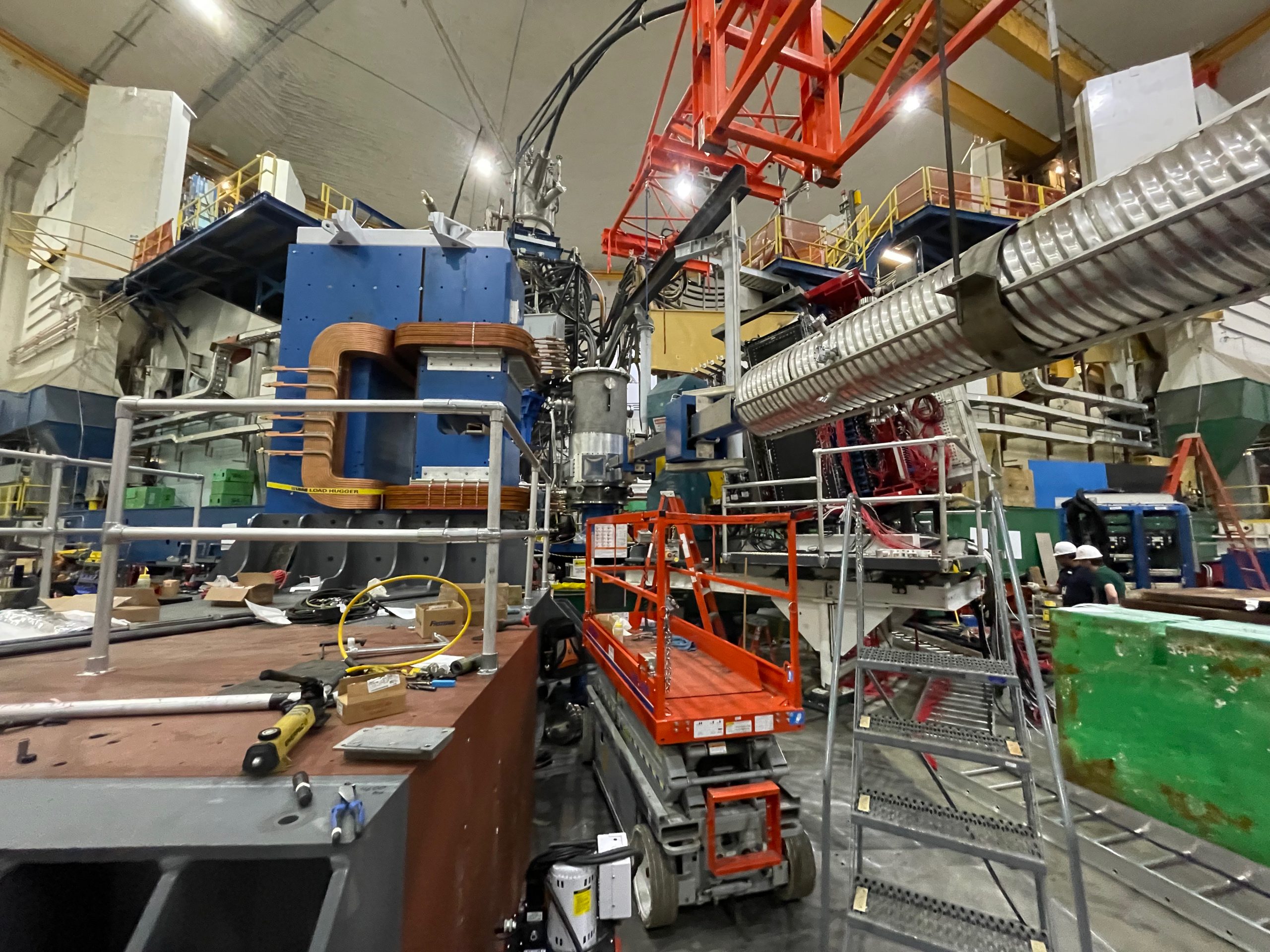
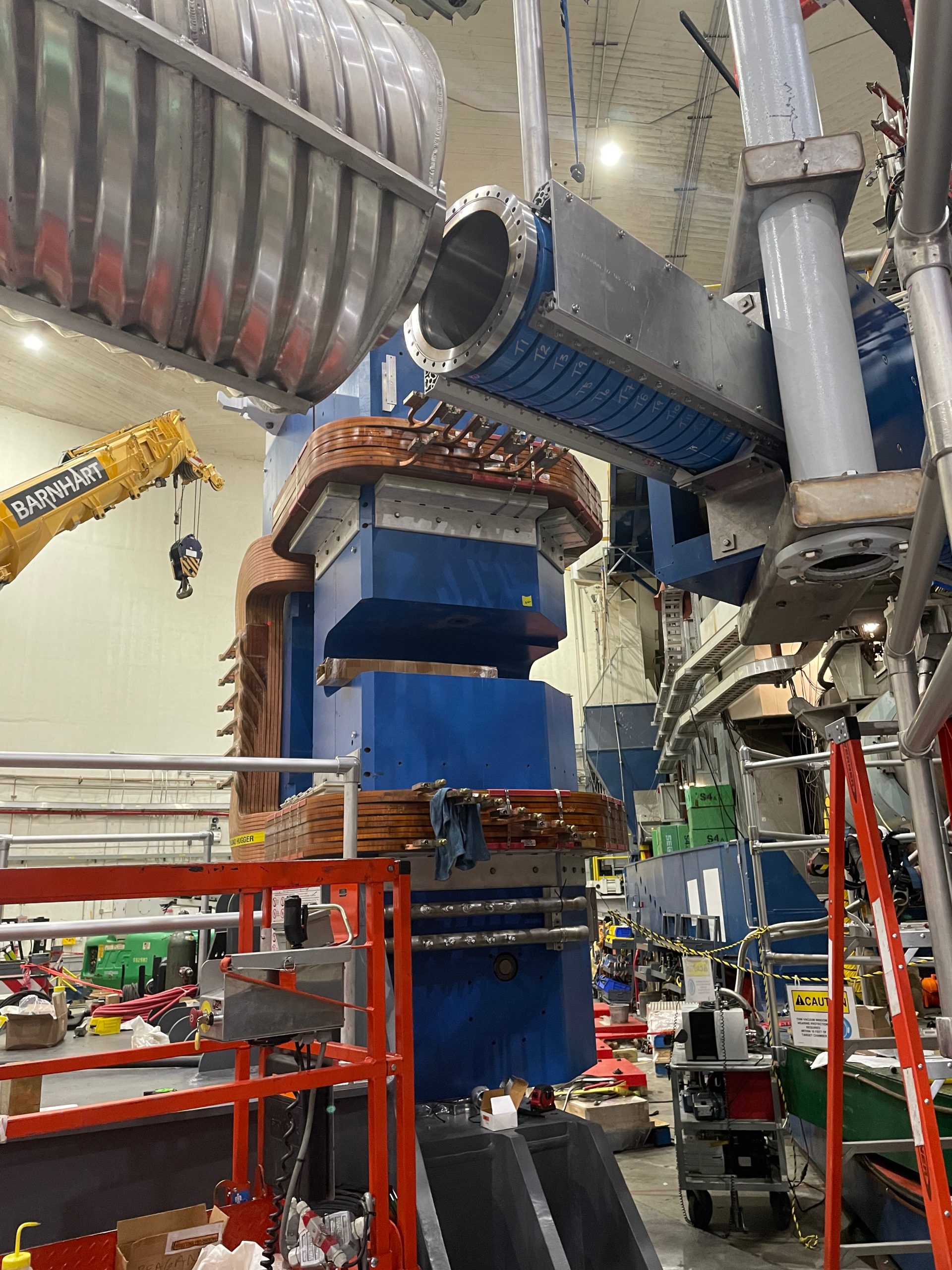
SBS dipole magnet in Hall A, July 2021. The magnet will provide a small vertical deflection of scattered protons so that they can be distinguished from neutrons, which are undeflected, in the SBS Hadron Calorimeter
Rear view of the SBS Hadron Calorimeter, showing photomultiplier tubes and front-end electronics.
View of downstream beampipe and the BigBite spectrometer from beam right.
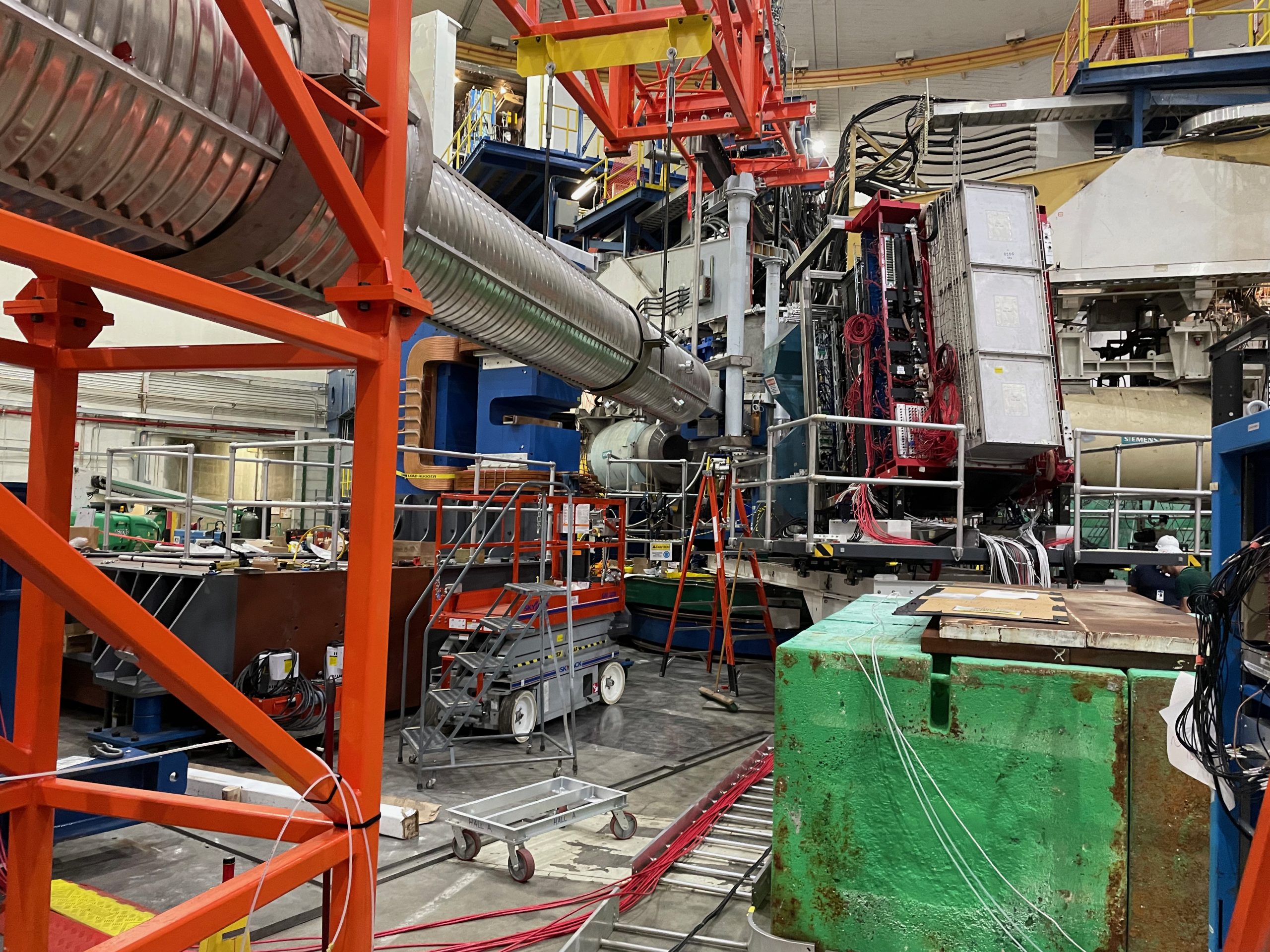
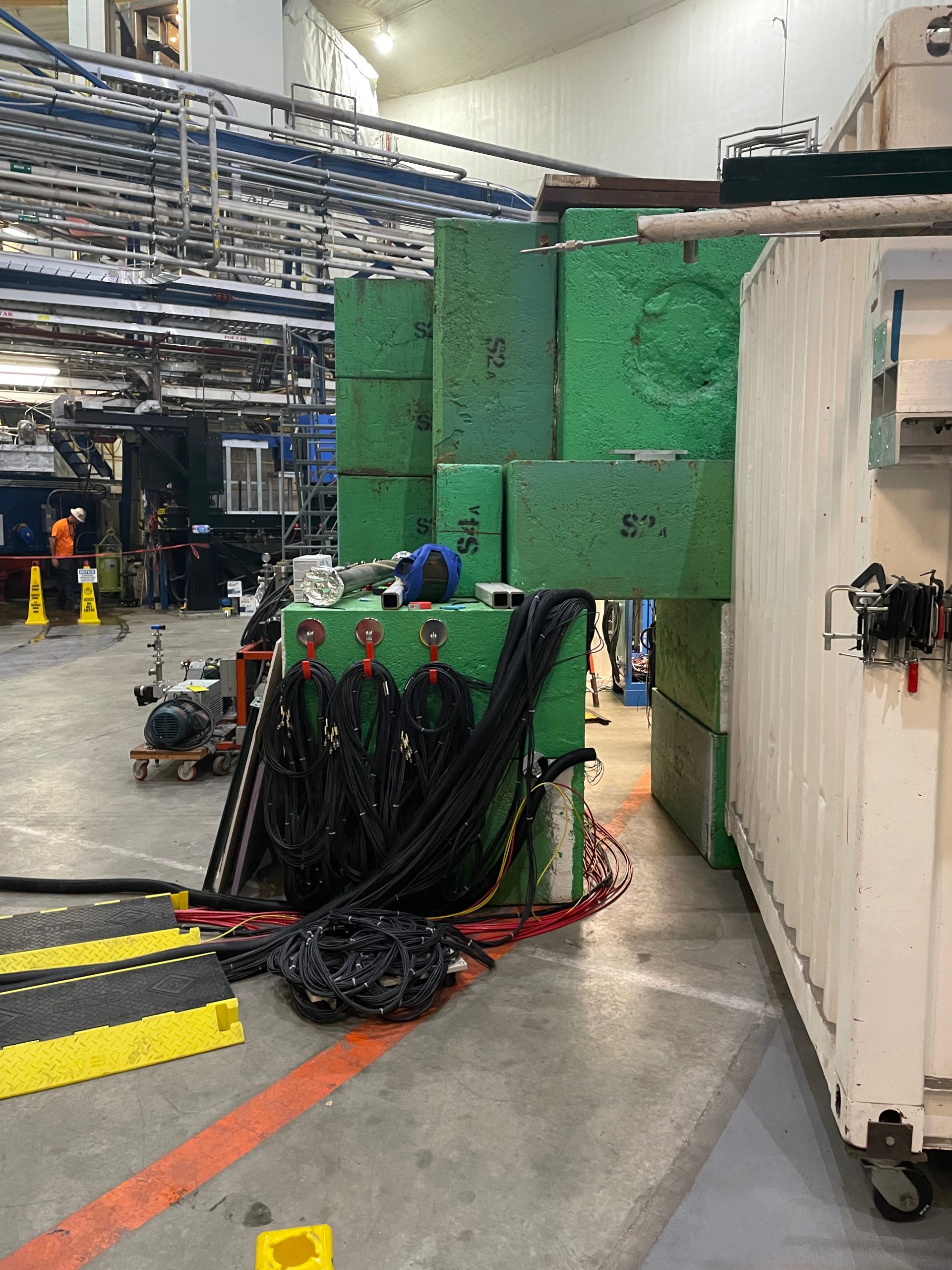
Beam-left view of the downstream beam pipe, the SBS dipole magnet, and the scattering chamber where the electron beam will collide with protons and neutrons in liquid hydrogen and deuterium targets
The UConn group on the BigBite Spectrometer platform. From left to right: Professor Andrew Puckett, Postdoctoral Research Associate Eric Fuchey, and Graduate Research Assistants Sebastian Seeds and Provakar Datta.
The UConn group on the SBS Hadron Calorimeter electronics/service platform.
UConn group on the SBS Hadron Calorimeter electronics/service platform. From left to right: Provakar Datta, Dr. Eric Fuchey, Sebastian Seeds, Prof. Andrew Puckett
Another view of the evacuated scattering chamber containing the cryogenic hydrogen and deuterium targets (and other ancillary targets), the downstream beam pipe, and the SBS dipole magnet, from beam left
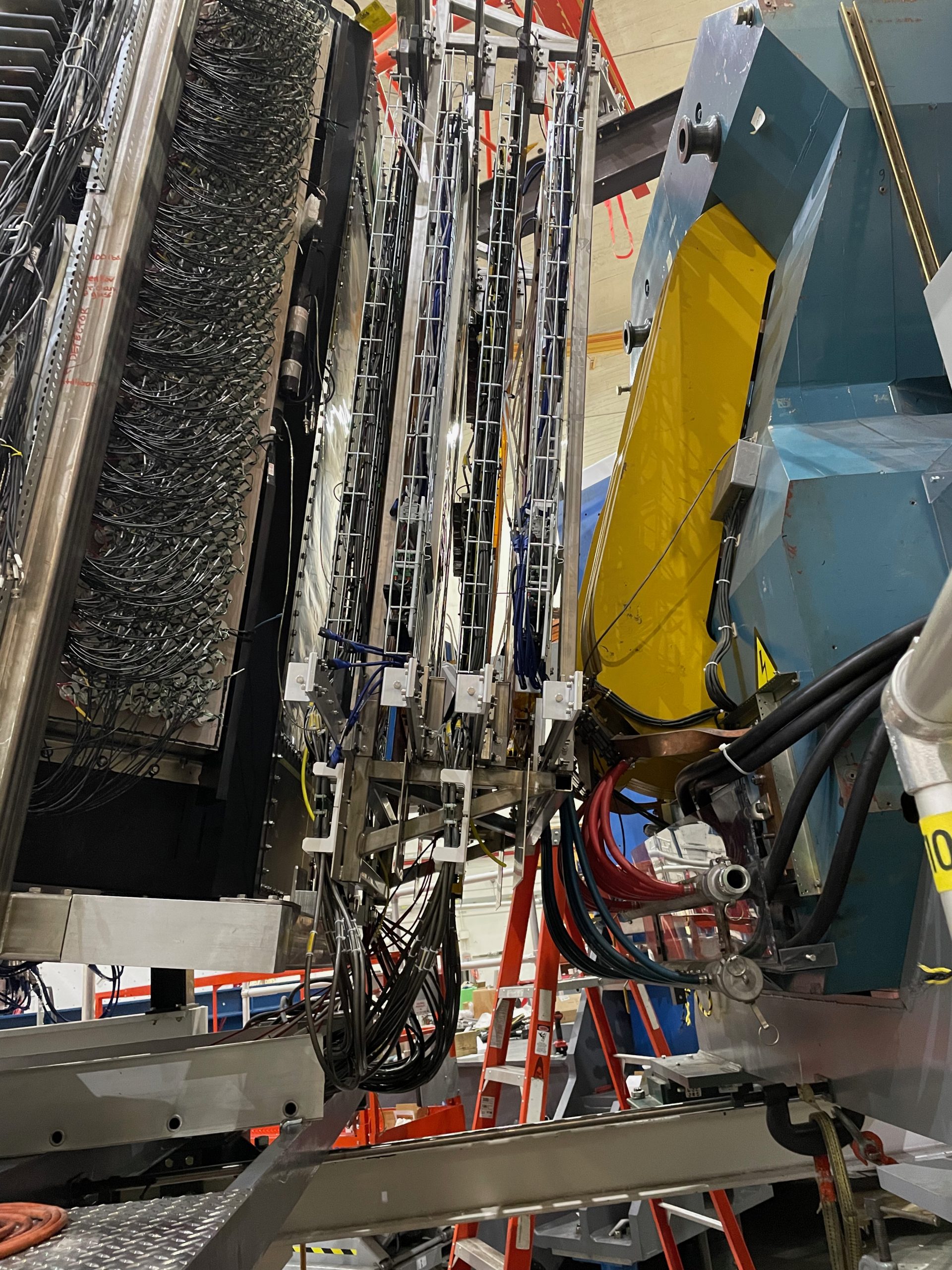
Close-up view of the Gas Electron Multiplier (GEM) detectors installed in the BigBite Spectrometer. These detectors will track scattered electrons.
Close-up view of downstream beam pipe and the SBS dipole magnet.
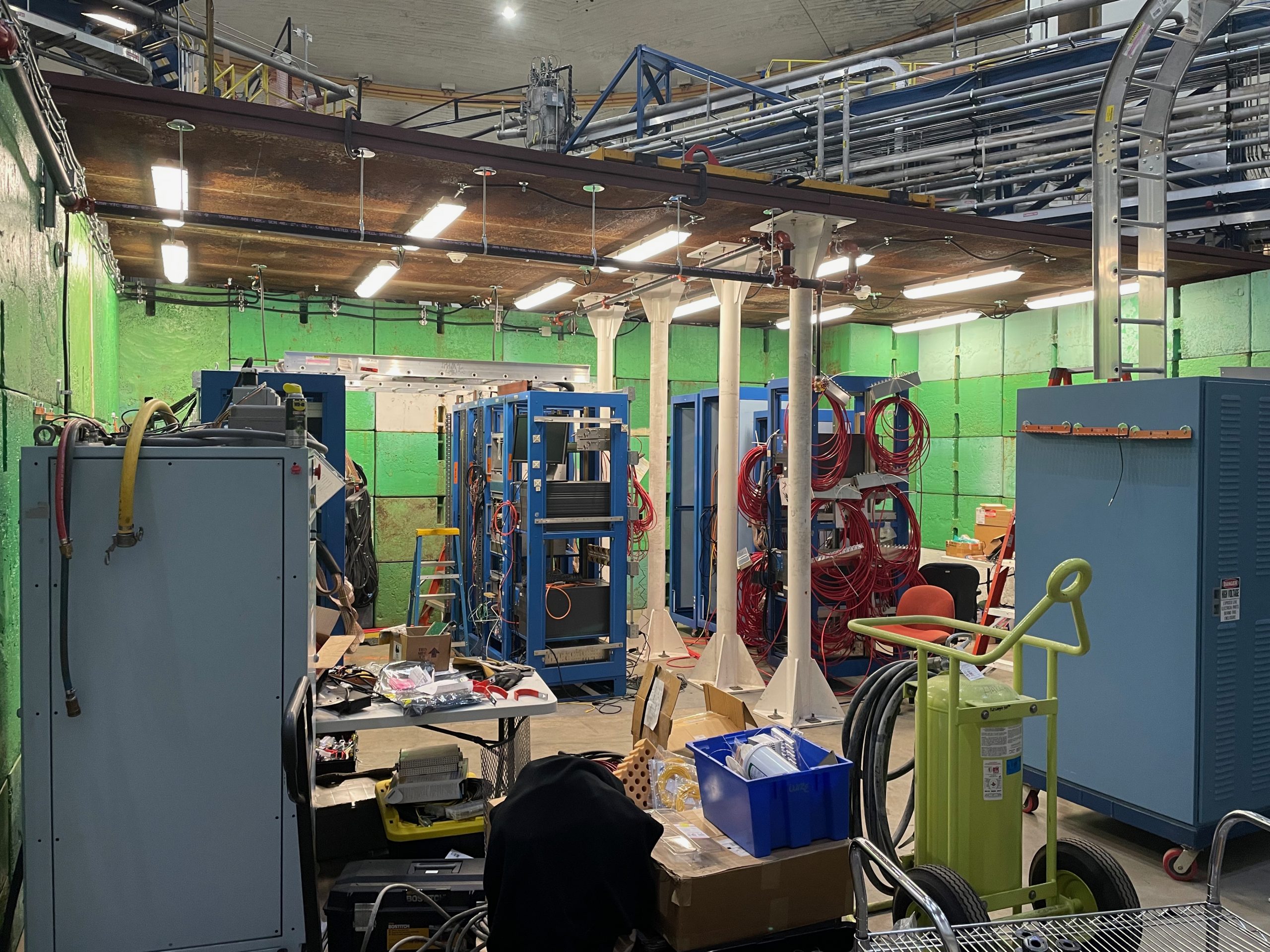
Electronics racks inside the radiation-shielded electronics bunker
Cable penetration in the radiation shielded electronics bunker
Front view of the shielding bunker for the radiation sensitive readout electronics used to record the signals from the detectors
Professor Andrew Puckett’s research group is currently leading, as part of a collaboration of approximately 100 scientists from approximately 30 US and international institutions, the installation in Jefferson Lab’s Experimental Hall A of the first of a series of planned experiments known as the Super BigBite Spectrometer (SBS) Program, with beam to Hall A tentatively scheduled to begin in early September of 2021. In addition to Professor Puckett, the UConn group’s involvement in this effort includes Postdoctoral Research Associate Eric Fuchey, and Graduate Research Assistants Sebastian Seeds and Provakar Datta. The first set of experiments is focused on the measurement of neutron electromagnetic form factors at very large values of the momentum transfer Q2, which essentially probe the spatial distributions of electric charge and magnetism inside the neutron at very small distance scales, on the order of 20 times smaller than the charge radius of the proton.
Electrons from Jefferson Lab’s Continuous Electron Beam Accelerator Facility (CEBAF), with energies of up to 10 GeV (=10 billion electron-volts), will scatter elastically from protons and neutrons in a liquid deuterium target in Hall A. Scattered electrons will be detected in the upgraded BigBite Spectrometer, located on the left side of the beam, while the high-energy protons and neutrons recoiling from the “hard” collisions with the beam electrons will be detected in the SBS by the newly constructed Hadron Calorimeter (HCAL), located on the right side of the beam. The SBS dipole magnet will provide a small vertical deflection of the scattered protons, which allows HCAL to distinguish them from scattered neutrons, which are undeflected by the magnetic field, but produce otherwise identical signals in HCAL.
The first group of experiments will answer several important questions about the “femtoscopic” structure of the neutron, including:
What is the behavior of the neutron’s magnetic form factor GM at large momentum transfers? The SBS experiment will dramatically expand the Q2 reach compared to all previously existing neutron data, from approximately 4 –> 14 (GeV/c)2. See original experiment proposal here. Figure 1 shows the projected SBS data together with existing data and selected theoretical predictions for the high-Q2 behavior of this form factor.
Figure 1: Projected SBS program results on the neutron magnetic form factor, compared to existing data and selected theoretical predictions
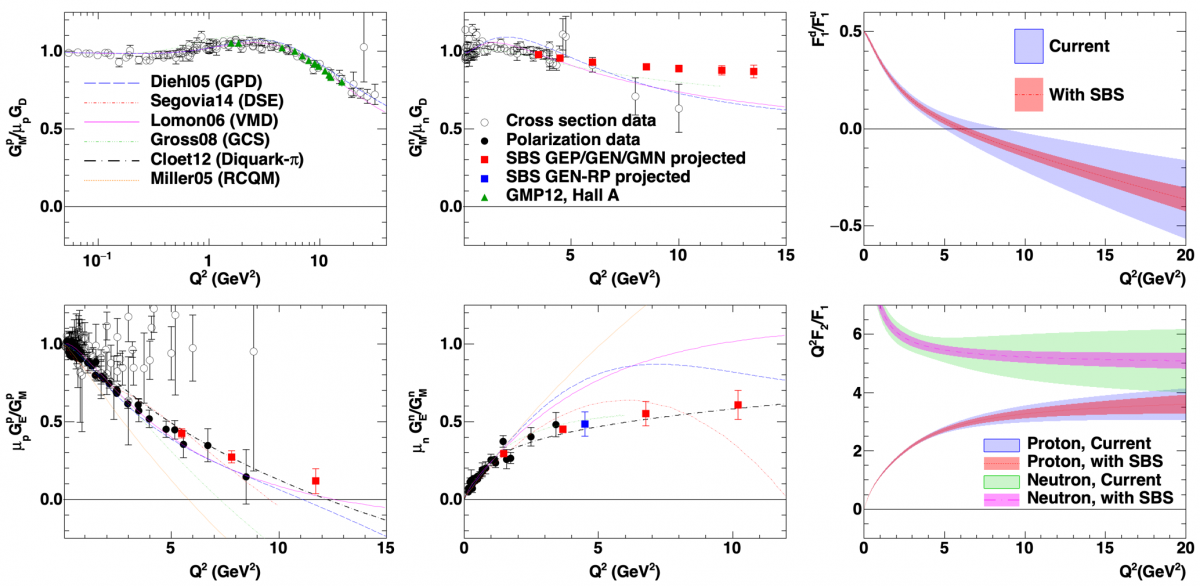
How is the charge and magnetism of the proton shared among its “up” and “down” quark constituents as a function of Q2? The proton magnetic form factor has been measured over a much wider range of Q2 than the neutron, and combined proton and neutron measurements can be used to disentangle the contributions of “up” and “down” quarks (and diquark correlations) to the proton’s structure, under the assumption of charge symmetry of the strong interactions (see, e.g., https://inspirehep.net/literature/1812076)
Projected results on nucleon electromagnetic form factors at large momentum transfers (Q^2) from the upcoming SBS program in Hall A at Jefferson Lab. See https://inspirehep.net/literature/1812076 for more details.
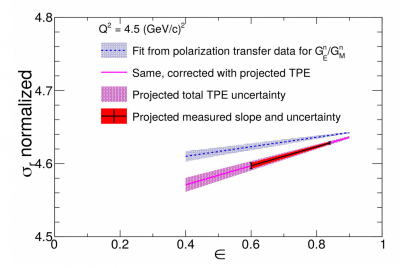
How important and/or significant is the contribution of two-photon-exchange to elastic electron-neutron scattering? The first SBS experiment group will perform measurements of the electric/magnetic form factor ratio for the neutron using two different techniques known as “Rosenbluth Separation” and “Polarization Transfer”, at a Q2 where these two techniques have shown significant disagreement for the proton. Both measurements will be the first of their kind for the neutron at such large Q2 values (see, e.g., Polarization Transfer Proposal and Rosenbluth Separation Proposal).
Projected results of the planned Rosenbluth Separation measurement of the neutron form factor ratio, to be compared with the companion polarization transfer measurement of the same ratio at identical kinematics. The experiment will provide a precise test for the neutron of theoretical calculations of two-photon-exchange contributions thought to explain the discrepancy observed for the proton.
Experiment E12-09-018 (the SBS SIDIS experiment) in Jefferson Lab’s Hall A, first approved by JLab PAC38 for 64 beam-days with an “A-” scientific rating in 2011, was evaluated under the Jefferson Lab Program Advisory Committee’s jeopardy process, which periodically reconsiders the approval status, beam time allocation, and scientific rating of experiments which have been approved but not yet scheduled after a certain amount of time. The experiment is currently expected to run some time in 2023. PAC49, held during July 19-23, considered the continued science motivation for the experiment and reviewed the progress in the preparation of the experiment since it was first approved, and re-approved it with no change in beam time allocation or scientific rating.
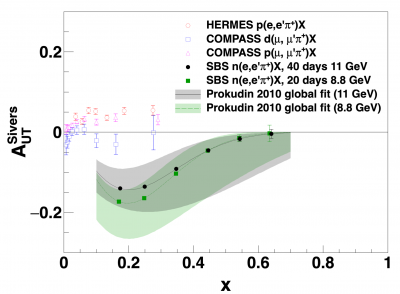
The experiment will measure so-called “single-spin asymmetries” (SSAs) in the production of charged and neutral pions and kaons in “deep inelastic” collisions of CEBAF’s continuous electron beam with transversely polarized neutrons in Helium-3 nuclei (transversely polarized means that the spin-1/2 Helium-3 nuclei, and therefore the unpaired neutrons they contain, have their nuclear spins preferentially aligned perpendicular to the direction of the electron beam). These asymmetries are sensitive to the orbital motion and transverse polarization of the neutron’s elementary quark constituents, and can provide for three-dimensional “imaging” of quarks’ motion and spin inside the neutron. The kinematics of the collisions, known as “Semi-Inclusive Deep Inelastic Scattering (SIDIS)” are chosen such that the cross section for the observed reaction is dominated by hard scattering of electrons by quasi-free quarks in the target neutron, and independent “fragmentation” of the recoiling quarks into observable hadrons (pions, kaons, etc).
By using the BigBite and Super BigBite spectrometers in Jefferson Lab’s experimental Hall A, together with an advanced, high-pressure helium-3 gas target polarized via spin-exchange optical pumping, that can withstand very high electron beam currents, the SBS SIDIS experiment will measure the SSAs for production of pions and kaons in “hard” electron-quark collisions on a neutron target with statistical precision 10-100 times greater than any previous experiment on either a proton or deuterium target. Measurements of SSAs involving transverse polarization of the nuclear spins are extremely challenging from an experimental point of view, and as such, very little new data have been collected on these effects for roughly the last decade. The SBS SIDIS experiment represents the best near-future opportunity to make significant experimental progress on these observables.
Figure 1 shows an example of the projected results of the SBS SIDIS experiment for π+ production on the neutron compared to existing data on proton and deuteron targets.
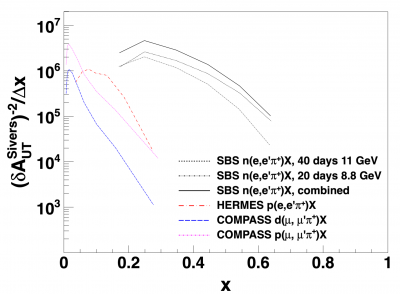
Projected results, with statistical uncertainties, of the approved SBS SIDIS experiment for the so-called “Sivers asymmetry” in the production of positive pions in “deep inelastic” electron-neutron collisions, compared to existing data from the HERMES and COMPASS collaborations on proton and deuterium targets (see linked proposal above for details).Projected statistical “figure of merit”, defined as the reciprocal asymmetry uncertainty squared, of the approved SBS SIDIS experiment (for positive pions only), per unit interval of Bjorken x, compared to existing data from the HERMES and COMPASS collaborations. Integrated over all x values, the SBS SIDIS experiment will reach a statistical figure-of-merit that is 10-30 times higher than any previously published measurement on a proton or neutron target, and 30-200 times higher for x > 0.1
Professor Puckett was elected by the Jefferson Lab User Community to a two-year term as an at-large member of the Jefferson Lab Users’ Organization (JLUO) board of directors (BOD).
More information about the JLUO, the BOD and their activities can be found here:
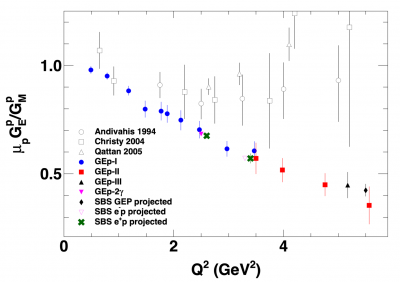
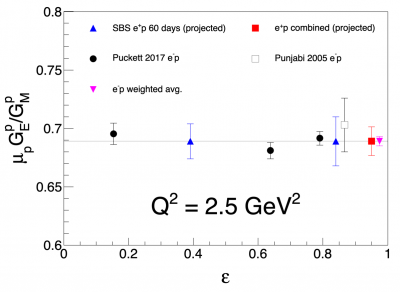
The European Physical Journal A has now published a paper led by Professor Puckett together with Professors Axel Schmidt of George Washington University and Jan Bernauer of Stony Brook University describing a future experiment to measure polarization transfer in positron-proton elastic scattering at large momentum transfers. These measurements would provide new information to constrain the effects of multi-photon-exchange in elastic lepton-proton scattering, thought to explain the discrepancy between cross section and polarization measurements in extractions of the proton electromagnetic form factor ratio at large momentum transfers.
Future positron-proton polarization data (green “x”-es) compared to existing cross section and polarization data as a function of the momentum transfer Q^2Proton form factor ratio at Q^2 = 2.5 GeV^2 versus the virtual photon polarization epsilon, comparing projected future positron-proton measurements (blue triangles and red square) to existing electron-proton scattering data.
The Hall A Collaboration at Jefferson Lab is reporting new precision measurements of the cross section for elastic electron-proton scattering at large values of the momentum transfer Q2 and low values of the virtual photon polarization ε. These new data significantly improve the precision of our knowledge of the proton’s magnetic form factor at large Q2 values. When combined with existing high-ε data at similar Q2, the new Hall A data allow us to nearly double the Q2 range for which it is possible to directly separate the contributions of longitudinally (L) and transversely (T) polarized virtual photons to the cross section, in a procedure known as Rosenbluth separation or L/T separation. In the one-photon-exchange approximation, this procedure allows us to separate the electric (GE) and magnetic (GM) contributions to the scattering. The new data are consistent with approximate form factor scaling; i.e., μp GE/GM = 1 (here μp = 2.79284734462(82) (according to PDG), is the proton’s magnetic dipole moment in units of the nuclear magneton). This result contradicts the expectations for this ratio based on precise measurements of the proton’s electric/magnetic form factor ratio using the polarization transfer technique. The new data significantly increase the range of Q2 for which significant two-photon-exchange contributions to the elastic electron-proton scattering cross section are conclusively established.
A manuscript reporting the new results has been submitted to Physical Review Letters. The preprint of the manuscript can be found here.
Proton magnetic form factor (in the one-photon exchange approximation) from the Hall A GMp12 experiment.Proton form factor ratio (in the one-photon-exchange approximation) from the new Hall A GMp12 experiment.


 Reload document
  Open in new tab